
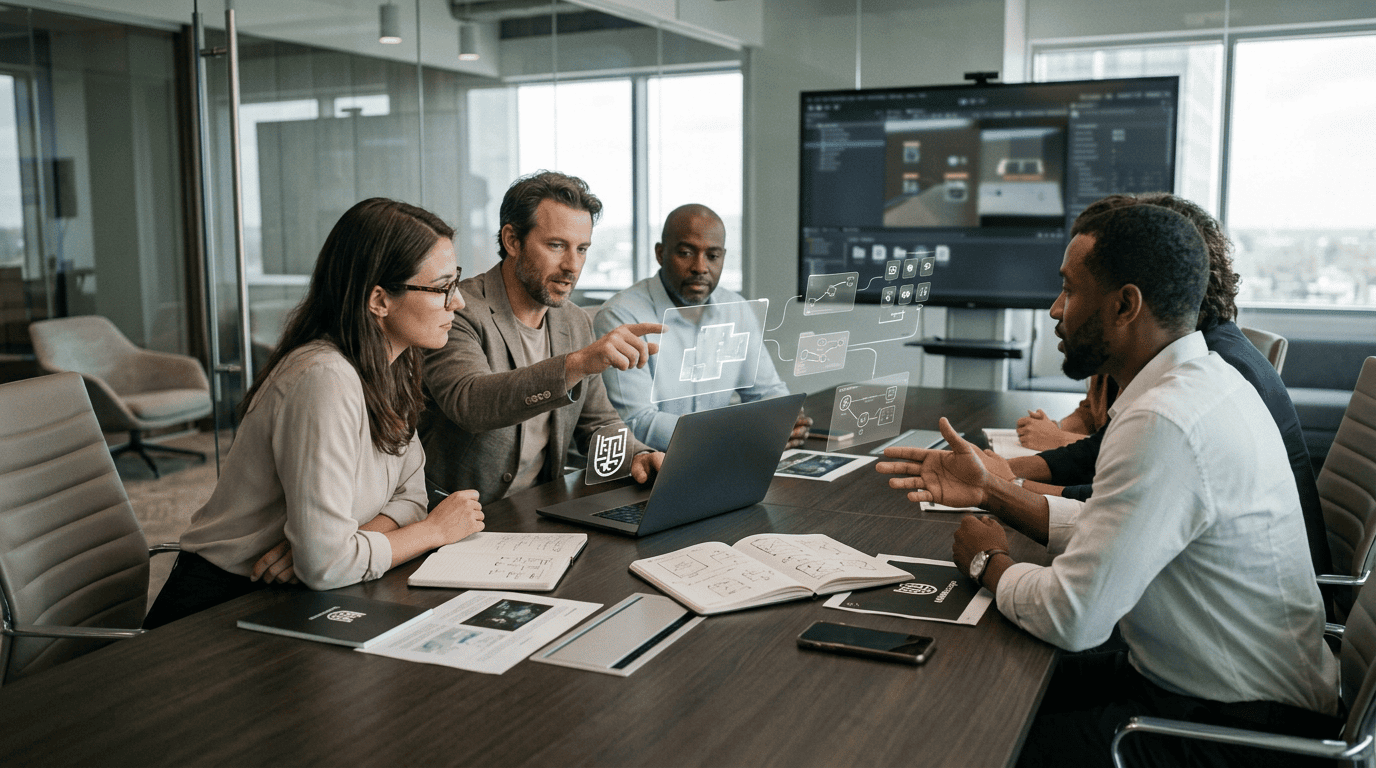
“We’d like to create our own game.” That one sentence opens up a surprising number of possibilities.
Digital? Analogue? Hybrid?
For a one-off event? Or as a permanent offering?
One location? Several?
A branded app? Physical game materials?
It’s tempting to jump straight into features, technologies and specific game formats. But the most important decision comes before any of that.
What Is the Game Actually Supposed to Achieve?
Should it communicate knowledge?
Bring a brand to life?
Engage guests?
Encourage people to explore a destination?
Enhance a training programme?
Create an unforgettable event experience?
A game can achieve many things. But it cannot do everything equally well at the same time.
A game designed to entertain people and bring them together requires a different approach from an experience intended to make complex information understandable or bring a brand message to life.
That’s why every project needs a clear purpose from the outset.

The first question isn’t: What kind of game should we create? It’s: What do we want the game to achieve?
This is where the development of custom Game Solutions begins.
Next Comes the Experience Architecture
Who will be playing?
In what situation?
For how long?
Individually or in teams?
What should players actually be doing?
What story will give the experience context?
Which game mechanics will create the desired level of engagement?
What content needs to be included?
Which physical and digital touchpoints make sense?
These questions gradually shape the experience itself. Only when we understand what people should do, discover, understand or experience can we determine the most suitable way to bring the concept to life.
And this is where things get creative. A digital game doesn’t necessarily have to take place outdoors. An analogue game isn’t automatically limited to a table. And a hybrid experience can work wherever combining digital and physical elements adds genuine value.
Digital, analogue and hybrid aren’t formats tied to particular locations. They’re different ways of bringing an idea to life.

And When Do You Need a Game Platform?
For digital and hybrid games, we use our own URBANescape Game Platform consisting of an app and backend.
It provides the technical foundation for different games, content and player access.
Once a game is set up accordingly, individual access can be generated automatically and delivered by email, allowing players to get started independently.
But not every project needs its own app.
A custom game can run on our existing platform.
Organisations that want to put their own brand front and centre can also choose a white-label Game App with their own name, branding and games.
And if additional games, locations or target audiences are introduced later, they can be added to the same technical foundation.
This means that designing the game experience and deciding whether to have a branded platform are two separate decisions.
This Is Where Our Expertise Comes In
At URBANescape, we don’t simply develop puzzles and then place them in an app or at a particular location.
We turn objectives, content and ideas into distinctive game experiences.
Our work covers concept development, storytelling, game design, challenges, dramaturgy and user journeys, as well as the development and implementation of the appropriate digital and physical game elements.
And the same initial challenge can lead to very different solutions.
A company wants to get its employees excited about a particular topic?
Perhaps a digital mission, an analogue team game or a combination of both would be the right approach.
A brand wants people to become active participants in its story?
That could take the form of a game at an event, a location-independent digital experience or an interactive adventure involving physical elements.
An organisation wants to engage several target audiences?
Perhaps the answer is a collection of games, each telling a different story while sharing the same technical foundation.
The setting or use case doesn’t automatically determine the format. The experience we want to create – and the conditions in which it needs to work – should guide that decision.

Your Vision. Our Game Expertise.
Some projects call for a compact, one-off experience.
Others require a long-term offering with multiple games, locations and a distinct brand identity.
Sometimes, a purely analogue solution is ideal.
In other cases, digital or hybrid elements open up entirely new possibilities.
The goal isn’t to use as many technologies or game mechanics as possible.
It’s to find the right combination to turn an idea into an experience that works, engages people and achieves its purpose.
That is exactly what our Game Solutions combine: custom game development, game design and – where needed – the technological platform behind the experience.
Your vision. Our game expertise. Our platform. Your game.
Not every project needs all of these elements.
But every great project needs the right combination.