
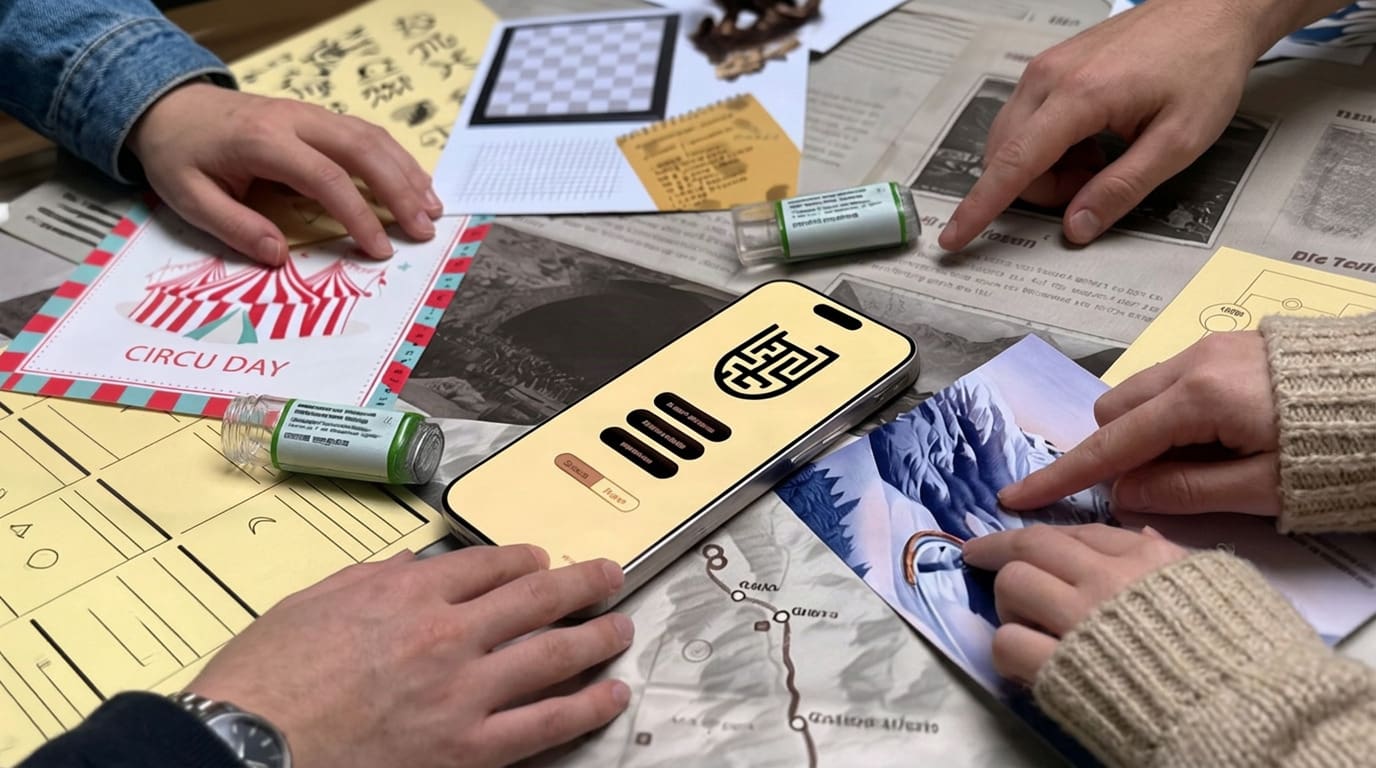
Putting together a jigsaw puzzle. Cracking a numerical code. Finding hidden clues. Solving a crossword. All of these activities can be fun. And all of them can be part of a well-designed game.cBut what happens when a company wants to use this kind of puzzle game to train its employees?
One common approach is to start with an existing game format and adapt the puzzles to the desired topic. Instead of an arbitrary image, a jigsaw puzzle might now show an organisational chart. A numerical code might be derived from answers to questions about a new business process. A crossword might contain terminology from a product training course.
The game now appears to address the intended subject.
But do participants actually learn anything about the relationships and processes they are supposed to understand?
This is where the difference begins between a puzzle game adapted to a particular theme and a learning game whose mechanics have been specifically designed around defined learning objectives.
A New Theme Doesn’t Mean New Game Design
Many traditional puzzles can be filled with almost any content. A jigsaw puzzle works the same way whether it shows a building, a company logo or a technical installation.
A combination lock can be opened with any four-digit code. And a crossword can contain terms from history, medicine or a company’s product catalogue.
There’s nothing inherently wrong with that. These activities can be entertaining, add variety to a story or encourage collaboration within a team.
The problem arises when adapting the theme is treated as equivalent to designing a meaningful learning experience.
Because if a puzzle can be solved without genuinely understanding the underlying subject, the learning content often remains interchangeable.
Players are primarily engaging with the puzzle mechanics, not necessarily with the relationships and concepts the company wants them to understand.
A game doesn’t become an effective learning game simply because its puzzles contain terminology from a training document.

When the Learning Content Determines the Challenge
Imagine a company wants to introduce its employees to a new internal process.
A simple game-based approach might involve printing the individual process steps on cards and asking players to arrange them in the correct order.
That can be useful if the learning objective is simply to remember a predefined sequence.
But what if employees need to understand why certain steps are necessary, how different activities depend on one another and what happens when information is missing or decisions are made too late?
That requires a different approach to game design.
Players could, for example, be given a mission to successfully resolve a complex customer case.
To achieve this, they would need to bring together information from different departments, identify responsibilities, resolve contradictions and determine which steps are necessary in a particular situation.
If essential information is missing, the task cannot be completed. If a process step is overlooked, there are consequences for how the game unfolds.
Players don’t progress by solving an arbitrary puzzle that happens to be decorated with company-related content.
They progress because they understand the process and apply it correctly.
The game mechanics reflect the very relationships and dependencies that the learning experience is intended to communicate.
That is a fundamental difference.

The Real Development Work Begins Before the First Puzzle
A custom Serious Game shouldn’t be developed by first assembling a collection of entertaining puzzles and then looking for suitable learning content.
The starting point is a different set of questions:
What should participants understand after playing?
Which relationships and dependencies are particularly important?
Where do misunderstandings or mistakes typically occur in everyday work?
Which decisions should employees be able to make independently?
And how can these specific requirements be translated into meaningful game challenges?
Only once these questions have been answered does the actual design of the game mechanics begin.
Sometimes the right approach is a challenge that requires players to combine information. Sometimes it’s a decision-making situation with different consequences. Sometimes it’s a complex task that can only be solved through collaboration.
What matters isn’t how unusual or complicated a puzzle appears.
What matters is what kind of thinking is required to solve it – and whether that thinking directly supports the intended learning objective.

Depth of Content Cannot Be Replaced by a New Visual Design
An existing puzzle game can often be adapted relatively easily for different companies.
Images, names, colours or individual texts are replaced. The game might even receive a new storyline.
For team events, entertainment or certain communication objectives, this approach can be perfectly appropriate.
However, when the goal is to communicate complex subject matter, introduce new business processes or develop an understanding of specific relationships, a purely thematic adaptation is often not enough.
Because the requirements differ from one organisation to another.
A learning game designed to introduce a new quality management process needs to encourage different ways of thinking and acting than a game about sustainability or one developed to train new employees.
The challenges need to emerge from the specific content itself.
That requires more conceptual work. It means exploring the subject in depth, understanding the relevant relationships and translating them into a coherent game experience.
At URBANescape, we consider this an essential part of developing custom Game Solutions.
We don’t simply insert learning content into existing puzzles.
We develop challenges that encourage players to discover the intended insights through their own thinking, reasoning and actions.

A Difficult Puzzle Isn’t Automatically a Good Learning Game
There’s another important distinction to make.
A puzzle can be extremely difficult and still contribute very little to the intended learning objective.
If employees spend twenty minutes deciphering a complicated numerical sequence, they may have demonstrated concentration, patience and logical thinking.
But have they gained a better understanding of the company’s new process?
Not necessarily.
Conversely, a seemingly simple task can have considerable learning value if it leads players to recognise an important relationship for themselves.
The quality of a learning game therefore depends neither on the number of puzzles nor on their difficulty.
It depends on how precisely the challenges are aligned with the intended insights and skills.

Good Learning Games Allow People to Discover Insights for Themselves
For us, one of the greatest strengths of learning games is that participants aren’t simply told what they are supposed to understand.
They discover it themselves. They try something out, recognise a connection, reconsider an assumption or find a solution together.
The insight isn’t simply a piece of information displayed after a puzzle has been solved. It emerges during the process of solving the challenge itself.
That requires game design for learning and training objectives that deliberately connects content, story, challenges and mechanics.
Not every puzzle game needs to meet this standard. Entertainment is a valid objective in its own right.
But when a game is specifically intended to communicate knowledge, deepen understanding or train the application of skills, the learning content cannot simply be the backdrop.
It needs to be an essential part of what players must do in order to succeed.
Because the crucial difference isn’t whether a game contains puzzles.
It’s why those particular puzzles need to be solved – and what players actually learn while solving them.